


Blogging Consistency: How to Publish Every Week Without Burning Out
Most blogs do not fail because the writer ran out of ideas. They fail because the writer published three posts in one excited week, then nothing for two months, then quietly gave up. The internet is full of blogs with a brilliant first month and a last post dated two years ago.
Blogging consistency is not about publishing every day. It is about publishing on a rhythm you can keep for a year — through busy weeks, bad weeks, and weeks when nobody seems to be reading. That rhythm is what Google rewards and what readers learn to trust.
What Blogging Consistency Actually Means
Blogging consistency means publishing useful posts on a predictable schedule — one you set yourself and can actually keep. It does not mean daily posting, and it certainly does not mean grinding yourself into the ground to hit an arbitrary number.
A reader who finds your blog through Google does not care how often you post — only that when they return next month, there is something new and the blog looks alive. Google works the same way: a site that publishes steadily builds a body of content search engines can trust, while bursts followed by long silences send the opposite signal.
The honest definition: consistency is a promise you can keep. One good post a week, every week, for a year, beats fifty posts in January and silence for the rest of the year. Most bloggers never reach 52 posts a year because they chose a pace they could only keep for a fortnight.
Why Consistency Matters More Than Volume
Google learns to trust a steady site. A blog that publishes regularly gets crawled more often and indexed faster, and the steady stream builds topical depth: twenty related posts on one subject tell Google your blog genuinely covers that topic. That is the heart of topical authority for bloggers — authority is built post by post.
Readers learn to trust a steady blogger. A visitor who subscribes is betting you will still be there next month, and every new post proves the bet right. A blog that goes quiet for three months loses even loyal readers, and winning them back is far harder than keeping them.
Your own skills compound. A blogger who writes every week for a year will be visibly better by December — faster at drafting, sharper at headlines, better at knowing what readers want. That improvement is impossible if you only write in bursts.
Pick a Publishing Rhythm You Can Keep for a Year
The most common consistency mistake is choosing a pace for your best week instead of your normal week. Your best week has free evenings and high energy; your normal week has work, family, chores and the occasional bad day. Plan for the normal week.
Count your real writing hours — research, writing, editing and publishing included — then match them to a rhythm:
| Time you have each week | A realistic rhythm |
|---|---|
| 2–3 hours | One post every two weeks |
| 4–6 hours | One post a week |
| 8 hours or more | Two posts a week |
One post a week is the sweet spot for most bloggers: enough to grow steadily without swallowing your life. What does not work is promising yourself three posts a week when you only have four hours, then feeling like a failure by week three.
Pick a publishing day and stick to it — a fixed day turns publishing from a decision into a habit. And start small: you can always increase your pace later, once one post a week feels comfortable.
If you are still deciding what your blog is about, that choice shapes your rhythm too. A narrow niche makes consistency far easier, because every post idea is obvious once you know your subject. Our guide on how to choose a blog niche shows how to test a topic before you commit to it.
The Weekly System: Batch Your Blogging Into Four Blocks
Most bloggers find weekly publishing exhausting not because of the writing, but because of the switching: researching, drafting, editing, finding images and promoting, all crammed into one chaotic evening. Batching fixes this — group similar jobs together and do each one once a week.
Block 1: Plan (30 minutes)
Pick next week’s topic from your idea bank, check what readers are searching for, and write a short outline: headline, three or four headings, key points under each. A good outline is half the post. Check whether your topic has a realistic keyword you can rank for — our guide to long-tail keywords for bloggers shows how to find phrases a small blog can win, using free Google tools.
Block 2: Draft (60–90 minutes)
Write the draft in one sitting, in a fixed writing hour if you can manage it. The rule is simple: no editing while you write. Set a timer and get the whole draft down — editing mid-draft is what turns a 90-minute job into a four-hour one. On a low-energy day, commit to just 100 words; once you start, the draft usually flows to several hundred on its own.
Block 3: Edit and polish (30–45 minutes)
Come back to the draft with fresh eyes, ideally the next day. Cut anything that repeats itself, check the facts, and tighten the introduction. Add images and internal links here, while you are in editing mode. A quick pass through our free Word Counter helps you check length and spot sections doing too much heavy lifting.
Block 4: Publish and promote (20–30 minutes)
Set the featured image, write the SEO title and meta description, choose the category, and hit publish. Then share the post once or twice where your readers actually are — your email list, one social channel — and move on.
Four blocks, roughly three hours a week, and the whole post is done without a single frantic evening. Give each block a fixed slot, so you never have to decide when to write — you just show up.

Build a Simple Content Calendar
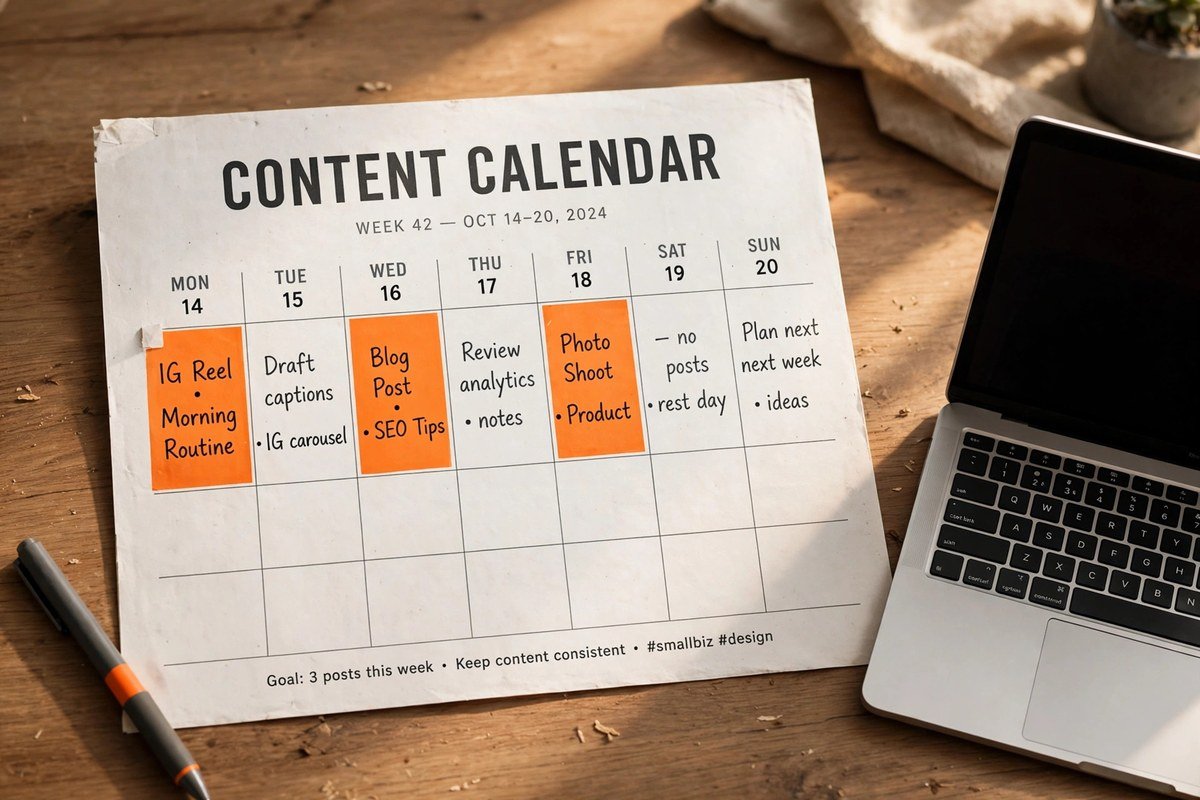
A content calendar is just a list of what you will publish and when — and it is the single most effective tool for staying consistent, because it removes the hardest decision in blogging: what to write about this week.
Keep it to one page — a spreadsheet or a notebook works fine. For each planned post, note the publishing date, topic, focus keyword and post type. Plan four to six weeks ahead, keep two or three outlines ready, and keep one or two finished posts in reserve for bad weeks. Keep a running idea bank too: a single list of ideas, topped up whenever a reader asks a question or you solve a problem.
The Minimum-Viable Week: What to Do When Life Gets in the Way
No system survives contact with real life unless it has a low-gear mode. Holidays, illness, work deadlines, family emergencies — something will disrupt your schedule, probably several times a year. The bloggers who stay consistent are not the ones who never miss a week; they are the ones who planned for missing one. So define your minimum-viable week in advance, while you are calm — the smallest version of your routine that still counts as keeping the habit:
- Publish from the reserve. Your emergency post goes live while you deal with life.
- Publish something shorter. A 600-word update or a quick answer to a reader question still counts. Not every post needs to be a 2,000-word guide.
- Update an old post instead. Refreshing an existing article keeps the blog visibly alive and often helps rankings more than a new post would. Our guide to updating old blog posts for SEO explains how to do this properly.
The rule: never let one missed week become two. Resume the normal schedule the following week, even if the post is shorter than usual — momentum is easier to keep than to rebuild.
How to Spot Burnout Early — and What to Do About It
Blogger burnout rarely arrives as a dramatic collapse. It creeps in as dread: you open your laptop and feel tired before you have written a word, and every post feels like homework. If that sounds familiar, do not push through it — pushing through is how a tired week becomes a dead blog.
Watch for the early signs: writing dread, where you keep finding reasons not to start; forced posts, where every article takes hours because you have no opinions left to draw on; shrinking ideas, where you cannot name your next five post topics; and envy, where you keep wishing you had started a different blog.
If two or more of these are true, treat it as a signal, not a failure — and reduce the load before you quit. Drop from two posts a week to one, or from one a week to one a fortnight. Take a planned break, announced to your readers, rather than an unplanned one that stretches into months. Spend a week updating old posts instead of writing new ones. And check whether the topic itself is the problem: if you no longer care about it, the answer may be a narrower focus, not more effort.

What to Measure Instead of Traffic
The hardest part of consistency is the silence at the start: you publish week after week and almost nobody reads. That is normal — visible results typically take three to six months — but it is the point where most bloggers quit, because they are measuring the wrong thing.
Traffic is a lagging indicator; it shows up months after the work. In the early months, measure the leading indicators instead: indexed pages, impressions in search results, and your publishing streak. Check the first two in Search Console — our guide to Google Search Console for bloggers shows which reports matter — and review quarterly, not daily: once every three months, run a simple blog SEO audit to see what is working and what to write next.
Frequently Asked Questions
How often should a new blogger publish?
One post a week is a realistic target for most new bloggers; one a fortnight is fine if your time is limited. What matters is keeping the same pace for months, not the pace you choose in your most enthusiastic week.
How long does it take for consistent blogging to show results?
Visible results — traffic, comments, rankings — typically take three to six months of steady publishing. The first signs appear earlier: posts getting indexed and impressions rising in Search Console. Stopping before month three is the most common mistake new bloggers make.
What should I do if I miss a week of blogging?
Resume the normal schedule the following week and do not try to make up the missed post. Publish from your reserve if you have one; if not, publish something shorter or update an old post. One missed week is life — the habit only breaks when it becomes two.
How do bloggers avoid burnout?
By choosing a pace they can keep, batching similar tasks, and having a planned low-gear mode for busy weeks. Burnout usually comes from an unsustainable pace or a topic you no longer care about.
Is it better to publish one long post or two short posts a week?
For a new blog, one thorough post a week usually wins: a single useful, well-optimised post has a better chance of ranking than two thin ones, and it is far easier to sustain. Depth and regularity beat volume every time.
The Bottom Line
Blogging consistency is not a talent. It is a system: a pace you can keep, four weekly blocks, a calendar, an idea bank, a reserve post, and a plan for bad weeks. Willpower runs out. Systems keep going.
Pick your rhythm this week: write your first outline, set your fixed writing hour, and publish on your chosen day. Then do it again next week, and the week after. A year from now, the bloggers who kept going will not be the most talented ones — they will be the ones who were still publishing.
If you want a head start, our round-up of free tools for bloggers covers the free utilities — word counters, readability checkers, meta tag tools — that take the fiddly jobs off your plate so your writing blocks stay focused on writing.